
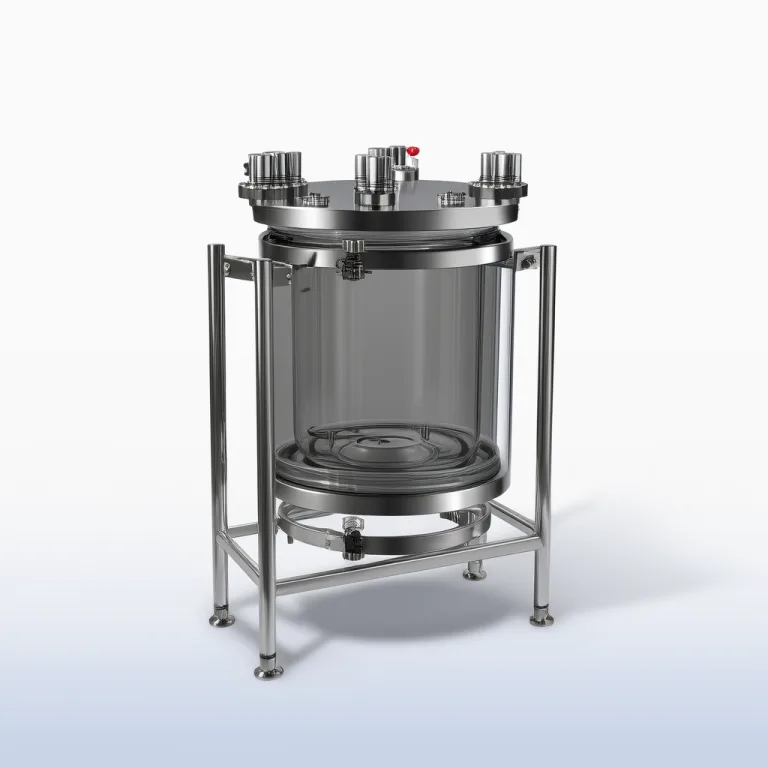
Jacketed Glass Reactor
Jacketed Glass Reactor for industrial applications.
About Jacketed Glass Reactor
Jacketed Glass Reactor for industrial applications.
| Domain | chemical |
|---|
Who Works With Jacketed Glass Reactor?
3 engineering roles are connected to Jacketed Glass Reactor based on verified research evidence.
Chemical Engineer
Chemical Engineer is a globally recognized, accredited engineering profession. In the context of industrial reverse osmosis systems, Chemical Engineers are routinely involved in system design (e.g., membrane selection, pretreatment chemistry, scaling/fouling analysis), process specification, operational optimization, troubleshooting (e.g., flux decline, chemical cleaning protocols), and overall plant/system management. The role is not product-specific — 'Chemical Engineer' does not embed 'Reverse Osmosis' or other product terms — so it remains canonical without generalization.
Chemical Process Engineer
Chemical Process Engineer is a well-established, widely recognized engineering role in the chemical industry. The evidence explicitly links this role to designing and troubleshooting jacketed glass reactor systems, developing SOPs for temperature-controlled reactions (directly relevant to jacketed reactor operation), performing thermal hazard analysis (critical for reactor safety), and supporting tech transfer — all core responsibilities aligned with reactor specification, testing, and operational management.
Chemist
Process Development Chemist is a widely recognized professional role in chemical and pharmaceutical industries, specializing in developing scalable, reproducible chemical processes. In the context of jacketed glass reactors — key tools for lab-scale process development — this role directly designs experiments, operates reactors under controlled conditions (e.g., inert atmosphere), and conducts testing (DOE, impurity profiling). While 'Process Development' denotes a specialization, it does not make the title product-specific (e.g., not 'Reactor Process Development Chemist'); the canonical role is 'Chemist', consistent with occupational standards (e.g., ACS, O*NET).