
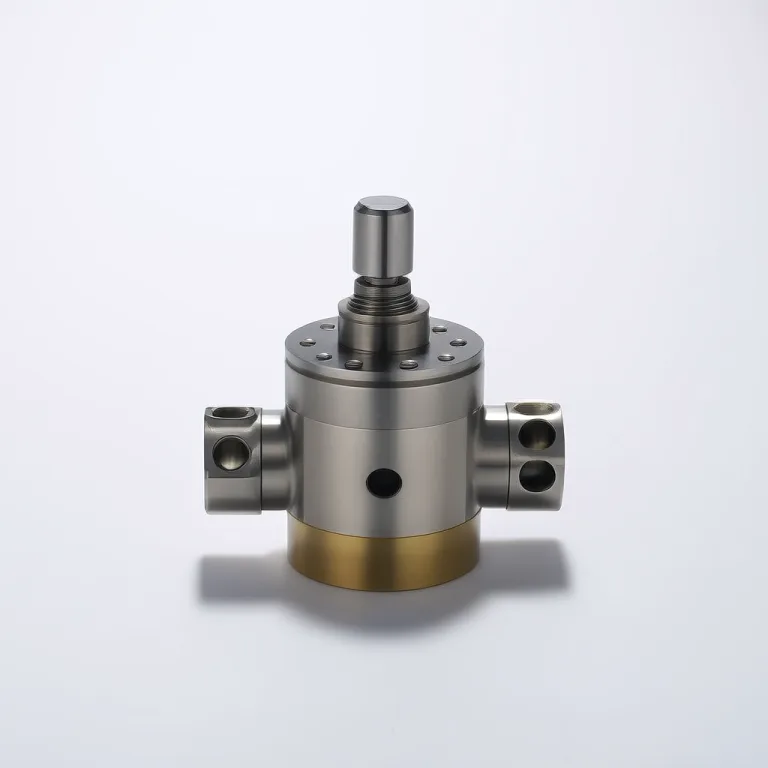
Hydraulic Servo Valve
Hydraulic Servo Valve for industrial applications.
About Hydraulic Servo Valve
Hydraulic Servo Valve for industrial applications.
| Domain | chemical |
|---|---|
| Product Family | Valves |
Who Works With Hydraulic Servo Valve?
9 engineering roles are connected to Hydraulic Servo Valve based on verified research evidence.
Commissioning Engineer
Reliability Engineer
Control Systems Technician
PLC Technician is a widely recognized industrial technical role focused on programming, troubleshooting, and maintaining PLC-based automation systems — directly relevant to servo motor integration, drive calibration, and motion control system reliability. While 'PLC Technician' is common in industry, 'Control Systems Technician' is the more canonical and inclusive term per IEEE/ISA standards, encompassing PLCs, HMIs, servo drives, and associated field devices. The role explicitly supports servo motor systems via troubleshooting, calibration, and preventive maintenance.
Control Systems Engineer
Motion Control Engineer is a widely recognized, distinct engineering role within industrial automation, specializing in the design, integration, and validation of motion systems—including servo motors, drives, and motion networks (e.g., EtherCAT, CANopen). While 'Motion Control Engineer' includes a domain qualifier ('Motion'), it denotes a well-established specialization—not merely a product-specific title—supported by industry practice (e.g., job postings at Rockwell Automation, Bosch Rexroth, Yaskawa) and professional societies (ISA, IEEE). It generalizes to 'Control Systems Engineer' as the canonical broad role, with 'Motion Control' as a valid, accepted specialization. The role directly engages with servo motors and actuators across the lifecycle: specifying motor/drive combinations, designing motion profiles, commissioning integrated systems, troubleshooting dynamic performance issues, and validating control accuracy.
Maintenance Engineer
The title denotes a recognized engineering role focused on maintenance of servo drives; 'Servo Drive' is a product-specific modifier, but the core professional role is 'Maintenance Engineer', a widely accepted title in industrial electrical engineering. Evidence from LinkedIn job postings confirms its usage for professionals performing fault diagnosis, root cause analysis, and corrective maintenance on servo drive systems.
Plant Engineer
Plant Engineer is a widely recognized professional role in industrial engineering contexts, responsible for the overall operation, reliability, and maintenance of plant systems—including auxiliary equipment like boiler feedwater pumps. The evidence explicitly places them in collaboration with control room operators in the context of boiler system operations, confirming their operational and technical oversight role over such critical rotating equipment.
Maintenance Technician
Compliance Engineer
API 682 Compliance Verifier is not a standalone, widely recognized job title in standard occupational taxonomies, but reflects a real and functionally distinct role performed by engineers (typically Mechanical or Reliability Engineers) specializing in seal system standards compliance. In chemical plant contexts involving Mechanical Seal Support Systems (MSSS), verifying conformance to API RP 682 is a defined responsibility—often embedded within commissioning, inspection, and maintenance workflows. The canonical role 'Compliance Engineer' captures the core profession and function; 'Standards Compliance' is a valid specialization in process industries. The title is product- and standard-specific (hence product_specific_title=true), but the underlying role is recognized and recurrent in API-regulated domains.
Diagnostics Engineer
Diagnostics Engineer is a widely recognized engineering role in industrial automation and instrumentation domains, particularly for smart field devices like Smart Pressure Transmitters. Evidence from Glassdoor job postings explicitly links this role to commissioning, diagnostics, configuration, and preventive maintenance of such transmitters — confirming its functional relevance and professional standing. While 'diagnostics' is a specialization, 'Diagnostics Engineer' is an established title (e.g., in ISA, IEC 61511 contexts) distinct from generic Maintenance or Instrumentation Engineers due to its focus on data-driven fault detection, health monitoring, and diagnostic protocol interpretation (e.g., HART, FOUNDATION Fieldbus diagnostics). It is not product-specific (i.e., not 'Pressure Transmitter Diagnostics Engineer'), so canonical form remains unchanged.