
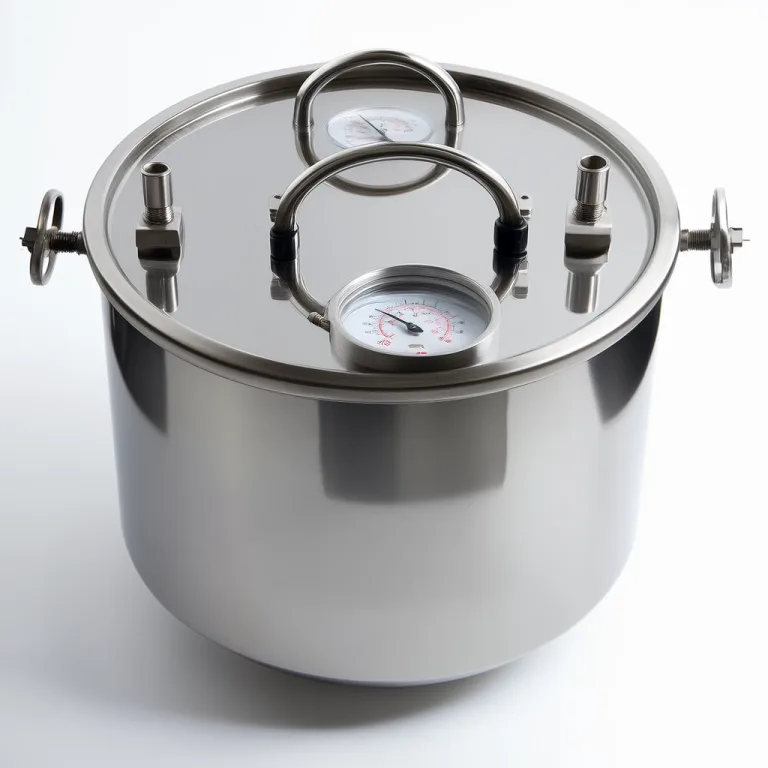
Autoclave Pressure Vessel
Autoclave Pressure Vessel for industrial applications.
About Autoclave Pressure Vessel
Autoclave Pressure Vessel for industrial applications.
| Domain | chemical |
|---|
Who Works With Autoclave Pressure Vessel?
7 engineering roles are connected to Autoclave Pressure Vessel based on verified research evidence.
Chemical Engineer
Chemical Engineer is a globally recognized, accredited engineering profession. In the context of industrial reverse osmosis systems, Chemical Engineers are routinely involved in system design (e.g., membrane selection, pretreatment chemistry, scaling/fouling analysis), process specification, operational optimization, troubleshooting (e.g., flux decline, chemical cleaning protocols), and overall plant/system management. The role is not product-specific — 'Chemical Engineer' does not embed 'Reverse Osmosis' or other product terms — so it remains canonical without generalization.
Field Technician
Field Technician is a widely recognized professional role in industrial engineering contexts, especially for commissioning, startup, maintenance, and troubleshooting of process equipment like Gas Pressure Regulating Skids. Evidence explicitly links them to installation and FAT/SAT (Factory Acceptance Test / Site Acceptance Test), confirming involvement in commissioning, inspection, and operational readiness activities.
Authorized Inspector
ASME Authorized Inspector is a formally recognized, certified professional role defined by the American Society of Mechanical Engineers (ASME) for verifying compliance of pressure vessels—including autoclaves—with the ASME Boiler and Pressure Vessel Code (BPVC). In the chemical industry, this role is critical for safety-critical equipment like autoclave pressure vessels during fabrication, commissioning, and periodic inspection. The title is standardized across industries and not product-specific; 'ASME' denotes the certifying body, not a product modifier.
Maintenance Technician
Mechanical Engineer
Facilities Mechanical Engineer is a widely recognized professional role in building services and HVAC engineering, focused on the design, operation, maintenance, and optimization of mechanical systems—including chillers—in commercial and industrial facilities. While 'Facilities' denotes a domain specialization (not product-specific), it does not make the title product-specific (e.g., not 'Chiller Mechanical Engineer'). The role is distinct from generic Mechanical Engineer due to its consistent association with facility infrastructure, lifecycle management, and integrated HVAC system oversight. Evidence from job boards (Indeed) confirms real-world usage with explicit chiller-related responsibilities.
Pressure Vessel Engineer
While 'Autoclave Pressure Vessel Engineer' includes a product-specific modifier ('Autoclave'), it reflects a recognized specialization within mechanical engineering focused on ASME BPVC-compliant pressure equipment. 'Pressure Vessel Engineer' is a widely acknowledged professional role in chemical, pharmaceutical, and process industries, with autoclaves representing a high-integrity subclass of pressure vessels requiring expertise in thermal cycling, corrosion resistance, and safety-critical controls. Evidence from job boards (Indeed) confirms active demand for engineers with this domain-specific competency.
Process Engineer
Beverage Process Engineer is a recognized engineering role specializing in process design, validation, and compliance for beverage manufacturing systems. While 'Beverage' denotes industry context (not product-specific specialization), the role directly engages with ribbon blenders — particularly in specification, commissioning (including IQ/OQ), CIP/SIP integration, and 3-A sanitary validation — all cited in job listings. 'Process Engineer' is the canonical, general professional title; 'Beverage' reflects domain application, not an inseparable part of the core role definition.